Three formats put food and drinks in front of your team, and they solve different problems. A vending machine is compact and employee-paid. A micro market is an open self-checkout shop with far more range. An office pantry is employer-paid and free at the point of use. Here is how Houston workplaces choose between them.
Vending machine service: compact and always on
A vending machine needs a few feet of wall, takes card and contactless mobile payment as well as cash, and runs unattended around the clock. That makes it the default for night shifts, guard posts, small break areas, and sites where floor space is tight.
The trade-off is range. A machine holds a fixed number of selections, so the product list is a shortlist rather than a shop.
- Soft drinks, water, and protein shakes
- Chips, snacks, and candy
- Card, contactless, and cash payment
- Restocking, date rotation, and service calls
Micro market service: a self-checkout shop in the breakroom
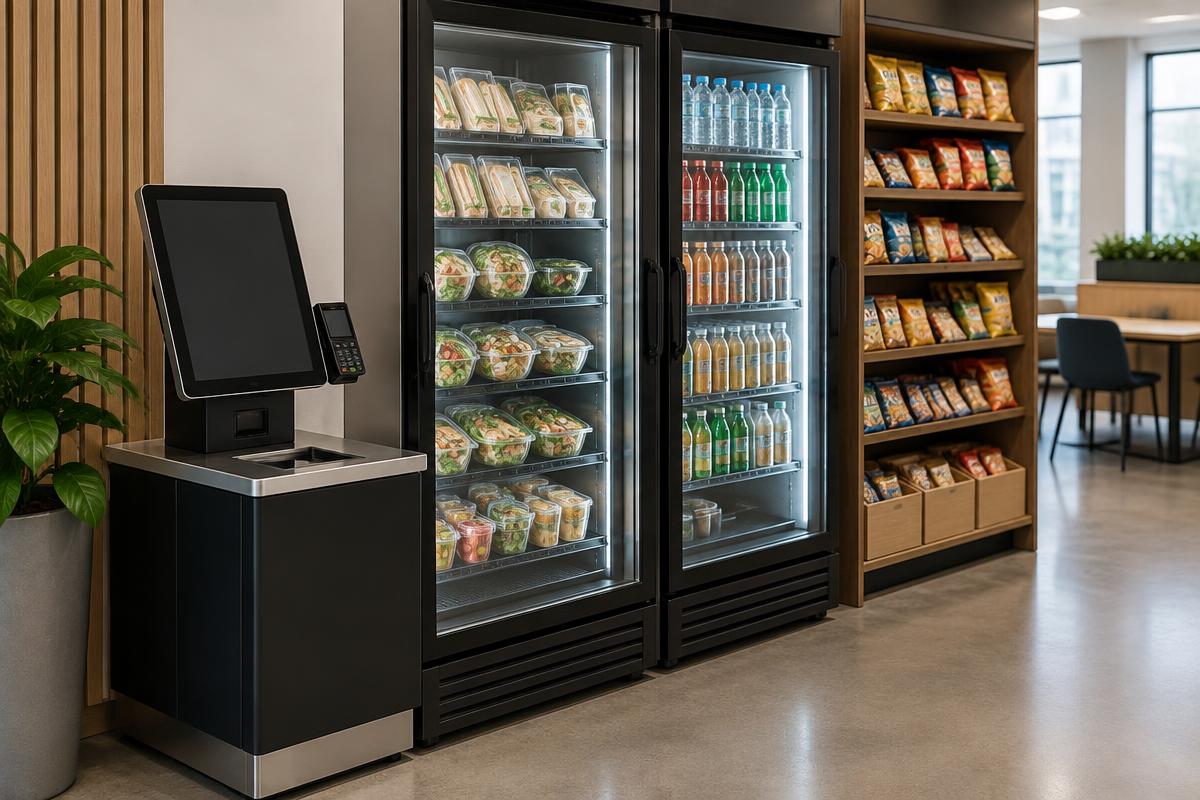
A micro market replaces the machine with open shelving and refrigerated cases plus a self-checkout kiosk or smart cooler. Employees pick items up, look at them, and pay at the kiosk with a card or phone.
Because nothing has to fit a coil or a spiral, the range widens considerably: fresh sandwiches and salads, breakfast items, packaged meals, better-for-you snacks. That is why larger Houston sites and multi-shift facilities move to this format once headcount supports it.
- Self-checkout kiosk with card and mobile payment
- Smart coolers for grab-and-go fresh food
- Open shelving for snacks and packaged meals
- Product mix tuned per site and rotated on dates
Office pantry service: employer-paid, free at the point of use
A pantry is not retail. The company buys the products and employees take them at no cost. It reads as a benefit rather than an amenity, which is why it shows up most in offices competing for talent.
Managed pantry service means the product list is curated, shelving and coolers are stocked on a schedule, and counts are taken each visit so par levels track real consumption instead of guesswork.
- Curated snack, breakfast, and better-for-you lists
- Open shelving, baskets, and beverage coolers
- Bottled and sparkling water and canned drinks
- Scheduled replenishment with per-location reporting
Who pays, and the middle option
Vending and micro markets are normally employee-paid at the point of purchase. Pantry is employer-paid. Between them sits subsidy: the employer covers part of the price so the kiosk charges a reduced amount.
Plenty of Houston workplaces run a hybrid — employer-paid coffee and pantry basics in the main breakroom, employee-paid vending on the warehouse floor.
Matching the format to the site
Small office with one break area: pantry, or vending if the budget should sit with employees. Mid-size office: pantry in the main breakroom, vending near the far end of the floor. Warehouse or plant running shifts: vending everywhere, with a micro market at the main break hall once headcount justifies it.
None of these are exclusive, and a site can change format as it grows. The practical question is how many people pass the space per day and whether the company intends to pay for what they take.