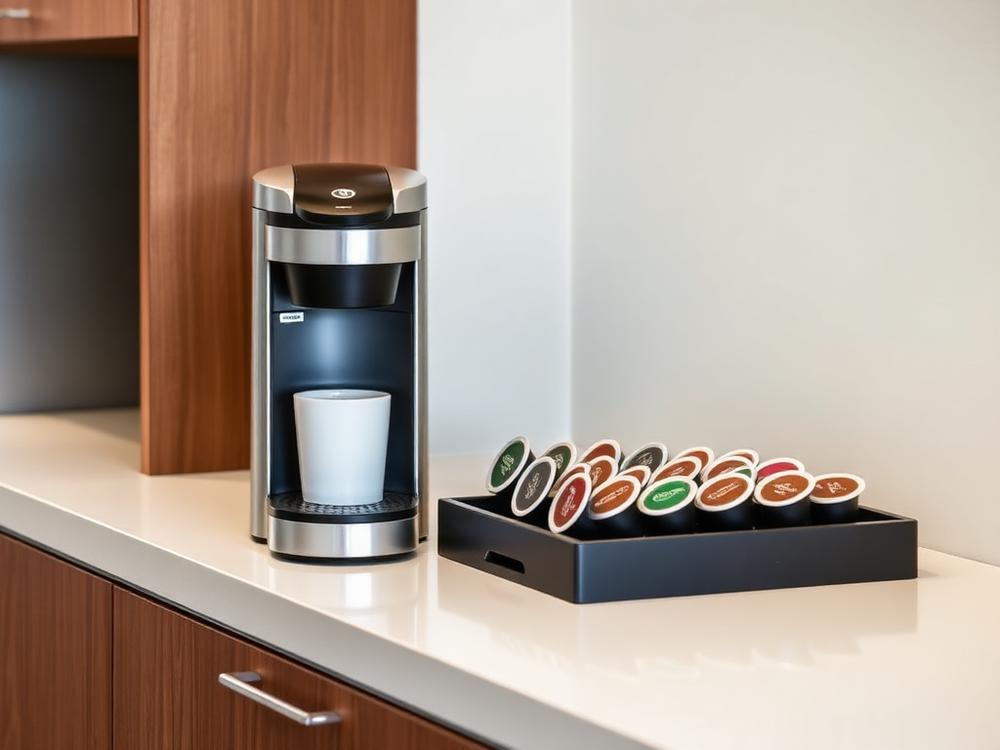
Office coffee service means someone else owns the whole coffee program: the machine, the supplies, the refills, and the service calls. Instead of an office manager tracking K-Cup counts and chasing a repair number, a local provider sets the breakroom up, keeps it stocked on a schedule, and maintains the equipment. Here is what that looks like day to day for a Houston business.
Step one: a walkthrough of your breakroom
Every program starts with a look at the space and how your team actually uses it. Headcount, shift patterns, the number of breakrooms in the building, counter space, water access, and existing equipment all change what makes sense.
A 15-person office with one counter needs something different from a warehouse running two shifts with a separate front-office breakroom. The walkthrough is where that gets decided instead of guessed.
Step two: equipment placement and setup
Based on the walkthrough, brewing equipment is matched to the space — single-cup brewers where variety matters, commercial batch brewers where volume matters, and additional beverage or ice equipment where the workflow calls for it.
Setup includes placing the equipment, confirming it runs correctly, and showing your team how to use it.
Step three: the supply program
Your breakroom gets a defined product list rather than a random assortment. A typical list covers coffee and tea, the items people expect alongside them, and the disposables that run out fastest.
- K-Cups and ground coffee
- Tea and hot chocolate
- Creamers, sugar, and sweeteners
- Cups, lids, and stir sticks
- Plates, bowls, and cutlery
- Filters and brewing accessories
Step four: recurring service visits
On a set schedule, a service tech visits each location, counts what is on hand in every breakroom, restocks to par levels, wipes down the equipment, and flags anything that needs maintenance.
Because counts are recorded per breakroom, usage patterns become visible over time. Par levels get adjusted so the popular items stop running out and the slow movers stop piling up.
What it removes from your plate
No purchase orders for coffee. No emergency runs to a warehouse store. No one on staff owning descaling and cleaning. No separate vendor for the ice machine and another for the janitorial supplies.
That consolidation is the practical argument for a managed program: one local partner, one schedule, one point of contact.